Anxiety is at an all-time high, and it’s impacting our sex lives.
The American Psychiatric Association’s annual mental health poll (2024) revealed that 43% of adults are feeling more anxious than ever before. Current events, climate change, the economy, and the US election are being credited as significant factors. We are losing sleep over it. We are worried for our families, our health, and the impact of emerging technology, causing increased stress and poorer mental health.
This technology has directly impacted our youth. Young people are living in a highly connected world where they are exposed to distressing world-wide media within their own bedrooms, while popular culture and social apps continue to dictate and dismantle their self-worth. They are shown to be the most affected by anxiety, with 26.6% of 18-29 year olds struggling with anxiety symptoms.
But, what is anxiety, and how does it affect our intimate relationships? And, how can it possibly play a role in the sex we are having?
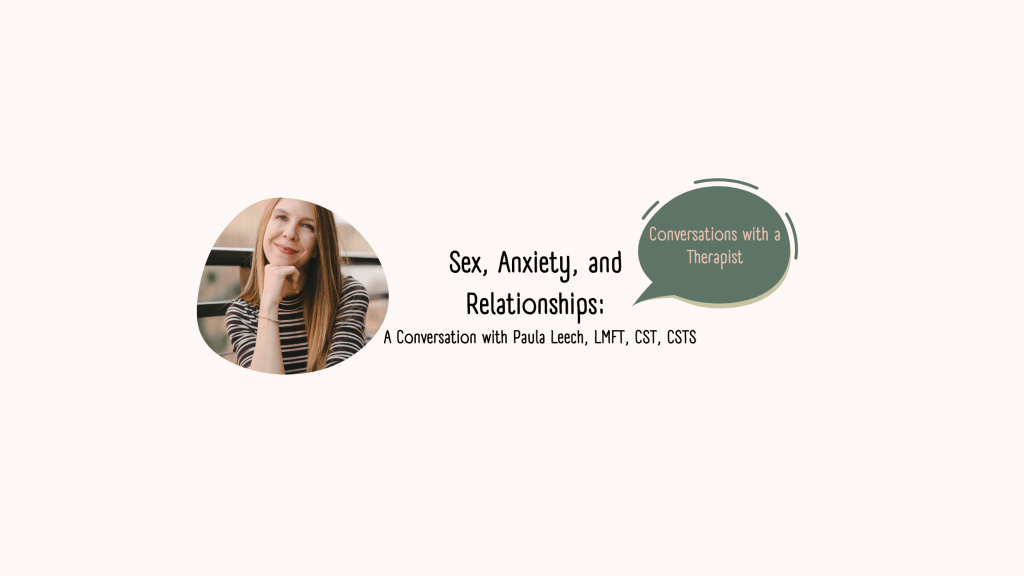
Paula Leech, LMFT, CST, CSTS, the author of Overcoming Anxiety in Sex and Relationships, is an expert on sex and anxiety. My conversation with her was enlightening, and I hope it is for you, too.
What is anxiety?
Anxiety describes both a physiological, i.e. a sensory and nervous system reaction in our body, and a neurological process that directly informs the quality and method of our thinking and behavior. For example, I can feel anxious in my body without any thoughts to accompany the sensation, or I can find myself in an anxious pattern of thought that inspires a physiological reaction, such as sweaty palms, that we often grow accustomed to. The psychology of anxiety often looks like this:
1. We are presented with a situation in the present
We are approaching a group of people you don’t know well at a conference.
2. We reference the past in order to gain some sense of control over what might happen
When I approached the “cool” kids in high school at lunch, they mocked me
3. We project a prediction about what might happen in the future
I’m likely to say something awkward
4. This directly influences our behavior
I’ll just hang back
To take this further, anxiety will draw inspiration from experiences we’ve had from the past and apply them to similar situations, alerting us of potential harm in the very near or very far-off future. It reaches back into memories or associations that felt like they were negative at best or traumatic or humiliating at worst, and from this our anxiety creates and casts its prediction. Consequently, the quality of the emotion tied to the memory is nearly never proportionate to the current situation or scenario. It creates stories about what might happen that are all fairly or completely catastrophic in nature, failing to reveal the often much-more-likely positive or neutral outcomes.
We react to these stories our anxiety creates for us as if they’re real rather than considerations or opportunities to check-in and get curious. Our fear (the base feeling from which anxiety arises) overtakes our logic. As a result, it often immobilizes us, preventing us from taking the necessary, healthy risks life requires for our ongoing growth. It lets us know where we experience distrust – in ourselves, in other people, in our contexts, and in an outcome.
Yet, like all emotions, anxiety is important because it provides information. It points us towards our wounds, barriers to intimacy, insecurities, and areas in need of healing. When it isn’t given the power to be the big bully, anxiety is a concerned co-passenger asking us to consider putting on our seatbelt in case of an accident. Anxiety and stress alert us to areas of caution in life, granting us forethought, promoting planning and safe and responsible behavior. It is trying to tell us why we struggle, but we have to dig within ourselves to find out what our anxiety is telling us, and why.
How can anxiety show up and impact our relationships?
Anxiety loves high stakes scenarios, and we are often very invested in the relationships we hold. This makes our relationships particularly vulnerable to anxiety’s influence when things fall out of rhythm or don’t go according to script. We see examples of this through controlling behavior (because we react to the fear of the unknown by reaching for control), and particularly after infidelity.
Anxiety can also be found lurking in our relationships as a result of what and where we learned about intimacy and closeness. This includes how we express feelings, our sense of safety in connection, stability of attachments, and ability to be seen.
Let’s take an example. Every time Anne gets in an argument with her partner, Claire, Anne shuts down and begins to acquiesce. Her brain predicts that if she is honest and speaks her mind Claire might leave, “abandoning” her as her mother did when she was younger. So, the psychology of anxiety proceeds as follows:
1. Take a situation in the present (conflict and disagreement with Claire).
2. Brain references the past in order to gain some sense of control over what might happen (memory of dad expressing his feelings in conflict and mom leaving)
3. Project a prediction about what might happen onto the future (If I share, she will leave me).
4. Which then directly influences our behavior (I’ll just be quiet and placate).
This is a subconscious process, and more or less clear depending on the person and/or scenario.
Finally, anxiety takes the healthy sense of separateness that lives between people and frames it as dangerous or something to eliminate or control. If we feel like we can finish each other’s sentences or predict what the other might be feeling, then we don’t have to sit with or confront the great mystery that is our partners. Therapist and author Esther Perel describes our inclination to “know” and erase the distance between self and other in relationships as detrimental to desire, seeing as desire thrives off of mystery.
Anxiety is a reaction to the unknown and our brain attempts to fill in the void when faced with limited information. In order to find a sense of safety, we try to convince ourselves that we “know” our partners in relationships, that we can understand, predict, and keep off the possibilities that suggest grief or heartache in the immediate or far-off future. Mystery is thrilling in the beginning, but then it becomes a threat to extinguish over time. However, by befriending the unknown rather than trying to follow anxiety’s lead, we can ensure we are not taking advantage of our partners, or taking them for granted. Understanding our partners as endlessly mysterious can help us partner with curiosity… endlessly.
In essence, by perpetually dating our partners and engaging in ongoing learning, this keeps intimacy alive and staves off the “familial” feeling that so often creeps into our long-term partnerships.
Does anxiety in our daily lives show up in the bedroom?
Anxiety can grab the “not good enough” idea that we all grapple with to varying degrees throughout our day, week, month, and have a field day with it. This becomes exceedingly apparent in the bedroom, especially when we’ve been taught that sex is something we need to “do well” in order to deserve love, receive validation, and demonstrate our worthiness as a potential partner. When we’ve been taught that an experience that is inherently vulnerable, an expression of feeling, a primal, abstract part of our animal nature is “performance,” we move into a goal-oriented mindset in the same way we would when interviewing for a job. It’s high stakes, high pressure, and full of potential to get it wrong (because what exactly does it mean to get it right?).
What can anxiety reveal to us in our sexual experiences? What is its message?
Sexually, the anxiety we experience is frequently connected to larger ideas and beliefs we carry about who we are, who we ought to be, what we should be feeling, how we need to be experienced, and what our worth is made of. It can be useful to ask ourselves in an ongoing way (or as it shows up in our experience): What is my sex-related anxiety showing me that has nothing to do with sex whatsoever?
Some of the most common messages embedded in our sexual anxiety include the following:
“You’re trying to control rather than letting-go.”
When sex asks that we let-go on repeat until we break through into surrender, anxiety shows us the places we’re holding on/holding back, distancing, hiding, or attempting to manage challenging emotions, memories, and associations.
“Your relationship with yourself is in need of care and loving attention.”
We are our primary partners in sex, even in shared experiences. Our anxiety can alert us to the difficulties we’re having with our bodies, with who we are, with how we express ourselves. If our self esteem has suffered after a particularly hard week, it might be difficult to want to “share” ourselves with another. Simply put, if we don’t like ourselves, don’t feel connected to ourselves (feel like we’ve vanished) or feel shame about who we are sexually, we tend to resist letting go into profound expression of ourselves (aka, sex).
“You’re thinking rather than feeling.”
Anxiety can illuminate when we’ve left our body, when we’ve left the experience as a guest, a participant, and have ventured into a higher-order of thinking/planning/managing as if engaging in a math equation rather than a form of play.
“You’re performing rather than expressing.”
This message can become increasingly apparent the more we attempt to resist the other colors of emotion that surface in the experience. If sex is only allowed to be one-note, namely fun and pleasurable every moment of the interaction, we will perform in the face of other feelings that surface or attempt to move away from emotion via performance.
“This was unsafe for you in the past, I’m giving you an emotional and physiological warning to try and keep you safe.”
Our brains will attempt to mitigate psychological, emotional, and/or physical harm, always. If sexual experiences or even energy meant harm in any capacity for us in our past, the brain predicts threat even when we are completely safe, even when we want the interaction, and will seek to create distance. This is a wise and important function, and it can make our sexual lives feel arrested when an anxiety warning is no longer needed. Sex therapy can help facilitate the formation of meaningful new predictions and associations that pave the way for a more easeful sexual life, if desired.
How can we work through anxiety to have the intimacy we desire?
We can help ourselves out in ways both big and small here, including:
- Stop making sex the New Year’s Eve experience of life (i.e., it must be fun every second or else it’s a huge disappointment).
Accept the full landscape of emotion in your sexual life, and your sexual experience (and functions) will thank you. Orgasm is catharsis, when we understand that many emotions will travel through us in our sex, that in and of itself is profoundly pleasurable, like going to see a really powerful film.
- Ditch the performance, intimacy is not an audition.
It is rich and intimate because we are sharing that which is private and deeply personal. When we try to be who we think our partners want us to be for them to have a good time, we leave our authenticity behind. Sex becomes a head game rather than a heart game. Daring to be yourself is not only an act of self-love, but it’s felt as an expression of love relationally.
- Understand that your brain is a prediction machine to favor self care,
What do you think your brain predicts when it comes to partnered sex? If “work” or “pressure” or “shame” come to mind, it gives you a place to start in terms of your sexual healing, in terms of the kind of conversations that may be necessary in our partnerships. Your sexuality is trying to help you, what is it attempting to say?
- Expect growth and expansion to be messy.
We understand that in order to find ease in learning a new skill, we have to approach, and then reapproach on repeat! When we go to follow our curiosity or try something new sexually and it feels a little awkward (which is inevitable), we decide it doesn’t work and abandon the mission. So much potential gets lost when it might’ve arrived a session or two later!
- Freely exercise boundaries and invite your partner to do the same (i.e. give yourself and your partner an off-ramp during sex).
Uncomfortable? Pivot. Tired? Stop. The only way to cultivate an approachable sexual life in an ongoing way is by making it one that moves away from obligation and that feels safe. This is one of the first things people cite when describing why they often prefer to masturbate before bed over partnered sex- “it’s such a commitment!” Befriending the word “no” leads to more “yes,” full stop.
The key ingredient to intimacy is risk. Sharing our bodies, our emotional experience, our vulnerability, our eroticism, means risking being seen for who we are beyond our roles, our brand, and the masks we wear in the various settings and situations we occupy. Anxiety shows us what we have to lose when we risk, putting us in touch with our fears of being left, seen as unworthy, a fraud, or (as is the case with many of us) even as the dorky, awkward kid that got bullied by their peers in middle school. We must dare to let go into who we are and how we feel to tap into the transformative power of sexual connection and experience.
If you found this article useful, you can buy Paula’s latest book Overcoming Anxiety in Sex and Relationships: A Comprehensive Guide to Intimate and Emotional Freedom (Routledge, 2025) here.
You can also see Paula’s therapeutic services on her website, as well as listen to her talk about sexuality topics on several podcasts and on her Instagram.
About Paula

Paula received her Bachelor’s Degree in Family and Human Development at Arizona State University and her Master’s Degree in Marriage and Family Therapy at the University of Massachusetts, at Boston. Post family therapy licensure, she became AASECT (American Association for Sexuality Educators, Counselors, and Therapists) certified as a Sex Therapist and worked with individuals, relationships, and families in private practice in Boston, Massachusetts for over ten years. In that time, she received AASECT certification as a Supervisor of Sex Therapy, and co-founded a sex therapy agency and training institute where she saw clients in addition to training therapists to become competent, confident sex therapists themselves.
Paula continues to regularly present at various training institutes as well as universities and therapy agencies across the US. She is the author of Overcoming Anxiety in Sex and Relationships: A Comprehensive Guide to Intimate and Emotional Freedom (Routledge, 2025).
Hi, I’m Heather – an award-winning book editor and content writer specialising in mental and sexual health. If you enjoyed this post, you can support this series by contributing to a coffee, or hiring me for my blog writing or editing services:
 Heather Evans Editorial
Leave a comment