Research into female sexual health conditions has been indisputably overlooked, undervalued, and underfunded. However, although there is still much work to do, the tides seem to be changing in terms of education, awareness, and empathy with regards to the menopause.
Staggeringly, The Menopause Charity has found that 51% of UK women report that the menopause negatively hurts their relationships. Along with 60% experiencing brain fog and 10% leaving their jobs because of their symptoms, 80% report that vaginal dryness impacts their sex life. Obviously, this has detrimental effects on women’s mental and sexual health.
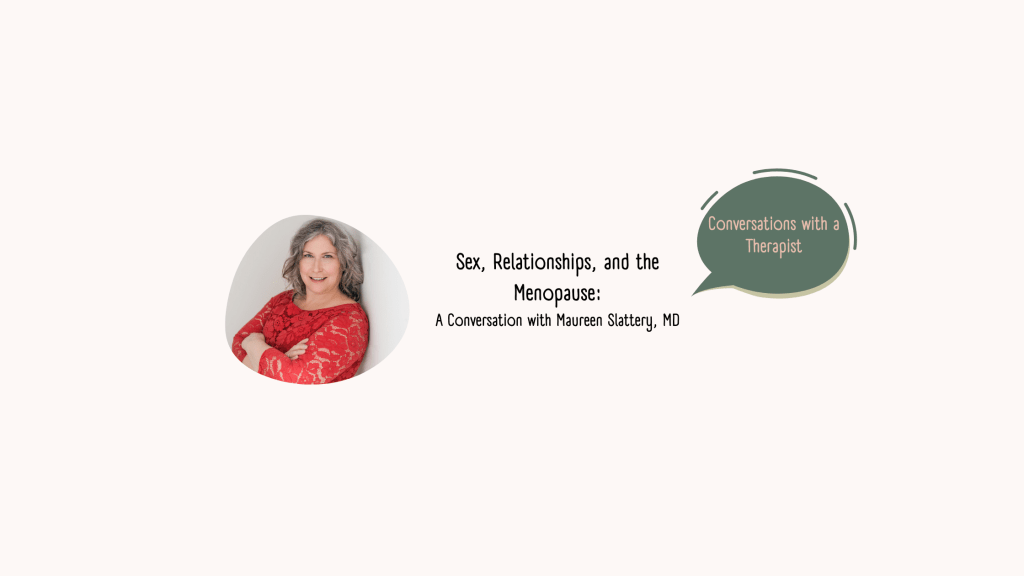
That’s why I had this conversation with Maureen Slattery, a physician and sexual health specialist at Rochester Regional Health. Focusing on sexual and romantic relationships, we discussed how we can address these statistics so that women, their sex lives, and their relationships can survive and thrive as they go through this transition.
What is the difference between the perimenopause and menopause?
Simply, the menopause is one year after the final menstrual period (FMP). It marks the end of the reproductive or ovulatory function of our ovaries, and it is also when the ovary stops producing oestrogen and testosterone.
Perimenopause precedes menopause. It is the duration of time when the ovaries are inconsistently ovulating and inconsistently producing hormones leading up to the FMP. This timeframe is variable but is noticeable for most women starting about 4 years prior to menopause. Women who still have their uterus will have periods of varying intervals (20 days to greater than 60 days between periods) during perimenopause. Cycle irregularity is the most universal symptom of perimenopause. For women who have had a hysterectomy, we can determine that they are postmenopausal with a persistently elevated level of the hormone FSH.
What are the symptoms and how do they impact our sexual health?
Vulvovaginal dryness is one of the most common pervasive concerns associated with the menopausal transition. I hear about it multiple times every day in my medical practice. We formally call this conglomerate of symptoms the genitourinary syndrome of menopause (GSM). It is especially problematic when it comes to penetrative sexual activity. Typically, it manifests as dryness, itchiness, and/or irritation in general, but it also can cause mild to severe painful sexual activity. I have had patients describe the pain when having sex as feeling like there is ground glass in the vagina or that penetration feels like someone is using a wire bottle brush in the vagina. It can be unbelievably painful! In counselling, and with my OBGYN patients, I tell them that you can’t truly want sex if it hurts. Painful sex needs to be addressed to have a fulfilling sex life.
GSM also has an influence on the urethra and bladder. When it is untreated, vulva owners have more symptoms of urinary urgency, leaking, and more bladder infections. The urinary tract infections after menopause are rarely caused by sex whether you are trying new positions or have new partners. The root cause is the lack of oestrogen in the tissue of these structures.
In addition to pain, decreased desire and difficulty with orgasms can be associated with menopause. More than a third of women have sexual complaints during this phase of life. Lower levels of oestrogen and testosterone contribute to these symptoms, but they are not the only factor. Sex is a bio-psycho-social and interpersonal activity. Our relationships, our sex education, and the society at large we are raised in all have substantial influence on desire. Furthermore, many common medications for conditions that are common in middle age can affect desire. Antihypertensive medications, and antidepressants are among the most common that can affect desire, arousal, and orgasms.
Are there ways I can manage my physical symptoms?
Yes! Let’s fix some of these physical issues! First and foremost, topical oestrogen to the vulvar vestibule can restore the pre-menopausal tissue moisture and elasticity. This reduces the day to day annoyance of irritation but can also significantly to completely remove the pain with intercourse.
Before anyone yells at me: “but oestrogen causes cancer!” I am here to dispel that myth for you. Topical oestrogen (when used appropriately) doesn’t cause cancer. It doesn’t even raise systemic oestrogen levels. We have several large studies that show that there is no difference in the incidence of uterine cancer in topical oestrogen users and non-users. Additionally there was a recent study that showed that use of vulvovaginal oestrogen did not increase the risk of breast cancer recurrence. If you have pain with penetration that is new during menopause, I would urge you to talk to your doctor about treatment.
If you really don’t want to use oestrogen, or you still feel uncomfortably dry despite topical oestrogen, vaginal moisturisers can help a lot! Most of these are hyaluronic acid based, and the appropriate pH for the vaginal tissue. They provide additional moisture to the vagina and are used typically 2-3 times per week.
Finally I want to give a shout out to lube! Lube for sexual activity is NOT a failure. It should be used for all penetrative and masturbation activities. Sex typically involves friction! Friction needs lube! Lube helps decrease pain and it has been shown to help with orgasm. Both the intensity of and ability to achieve orgasm is higher with use of sexual lubricants. Water based or silicone based products are helpful.
Is it normal for my sexual desire to change during this time?
Each individual’s libido is unique. Your interest in sex may be more, or less, or exactly the same as it was 20 years ago. If you are happy with your desire the way it is, then it is NOT a problem. Only when we are unhappy with our level of desire does it become an issue. Low desire is common around the time of menopause.
Approximately half of all women, starting in perimenopause, have concerns about their level of sexual desire. It is a common sentiment. I hate the term “normal” (because it assumes that some things are abnormal) but if almost half of all women over age 50 report lower desire for sex, then this change in life is somewhat “normal”. On top of that, anywhere from 7-12% women are bothered or distressed about their declining desire. When we are bothered by our low desire, it may be labelled hypoactive sexual desire disorder (HSDD). We spend a third of our lives in menopause – so not a small fraction of our lives! We don’t have to live with bothersome low sexual desire!
To those unhappy folx, I suggest considering getting medical help or talking with a therapist or counsellor about the specific changes you are dissatisfied with. Seeing a medical provider who specialises in sexual health can be beneficial. There are clinicians with training specifically for sexual health. In Europe, the European Committee of Sexual Medicine has providers who are well trained and you can find them (they will have FECSM after their names). You can also find doctors or advanced practice providers on the ISSWSH website (International Society for the Study of Women’s Sexual Health).
I am a big advocate for mental health counseling in general, however when it comes to our sex lives it can be a game changer. In the United States, there are specially trained professionals who are sex positive and skilled at working through concerns with desire and our changing bodies. AASECT-certified sex counsellors (CSC) and therapists (CST) are great resources and safe spaces to work thorough sex related concerns. Ignoring sexual concerns can have a profound impact on our relationship satisfaction, self esteem and quality of life.
What advice would you give to someone who doesn’t feel comfortable in their body or sexuality before, during, or after the menopause?
This is a frequent concern in my clinical practice. In fact, I hear this exact sentiment daily. Unfortunately for women, we grow up in a culture that holds thin, voluptuous, and youthful beauty as the gold standard. Those of us that are ageing (that’s all of us!) are fighting a losing battle with that unfair and unrealistic standard. Nevertheless, it is hard living in a body that is now behaving in a new (and often unfavourable) way. Dealing with those menopause related changes frequently impacts our sexual relationships.
Weight gain that is centred in the abdomen is a common change associated with the menopause transition. This is discouraging and difficult to manage despite a careful diet and regular exercise. When this leads to a poor body image, it also can both consciously and unconsciously lead to decreased interest in sex.
Poor body image is one of the biggest contributors to our sexual “desire” no matter the age or phase of life. Many studies show a link between poor body image and concomitant distress related to sexual satisfaction. Poor body image is also associated with poor orgasmic response. When we are worried about our weight and sexual attractiveness, or are thinking about our bodies during sexual activity, that correlates to low sexual satisfaction.
So how do we fix this? We fix it by loving our bodies anyway. We fix it by ignoring our brain when it tells us we aren’t pretty enough or thin enough or sexy enough. It’s not easy! If we can limit those negative self thoughts especially during the act of sex, that is a great place to start. The best case scenario is that our partners find us sexy and are kind and understanding when we tell them the physical and sexual changes we are experiencing. It can be reassuring to hear from them that they are still attracted to us and don’t care if we have, say, gained weight. Women can further work on keeping the negative self talk out of their sexual experiences by practising mindfulness. I know! I know! Mindfulness seems like it is the “so-called” answer to a lot of problems. In the case of having great sex and improving our self esteem, it works wonders! Mindfulness practice makes us better at putting negative self-talk out of our minds. When practised, we can do it without judgement and then refocus our energy on all the pleasure and connection that comes from our sexual activity.
How can I talk to my partner about intimacy during the perimenopause and menopause?
I love this question! Almost everyone would rather have sex with someone than talk to that someone about the sex they are having!
What I tell patients is that communication is the key. It fixes most of the issues people come to see me for. If your partner knows for example that you are having pain or dryness or you feel less desire to be sexual you can work together to find solutions that work for you both (all). We can’t assume that our sex partners know what we are experiencing.
I recommend talking when you both have plenty of time and are all in good spirits and not sleepy. You don’t have to be looking at each other if that is helpful so in the car or in bed just after turning the lights out works too. These conversations work best with “I” statements. That is to say, the initiator of the conversation says “I want to talk about…” or “I am having some trouble with dryness…” Or “I need to be honest about how I am feeling…”. This gives you ownership of the conversation and is non-confrontational. I also suggest avoiding saying things like “always” or “never” in relation to an open dialogue about sex. Finally if you focus on being a team with your mutual pleasure in mind it is easier to find your way forward. You will be surprised how a calm dialogue can improve your sex life!
If you found the information helpful in this article, you can find Maureen on LinkedIn, Twitter, and Instagram, or for more of her writing on the AARP website.
About Maureen

Maureen Slattery is a board-certified OBGYN with twenty years of clinical experience. She has advanced training in sex counselling and education, and is an AASECT-certified sex counselor. In addition to sexual health, her clinical practice also focuses on menopausal care.
Maureen has been featured in columns for the American Association for Retired Persons (AARP) on sexual health and ageing for those over 50, as well as writing for the Rochester Regional Health’s Health Hive on using HRT during menopause. She regularly teaches medical students, residents, and fellows about menopause and sex in Rochester NY. She has also been involved teaching medical students in a pilot elective about sexual health at the University of Michigan.
Maureen’s passion is twofold: helping patients find their pleasure in life, and educating health care providers about sex and sexuality. She believes that pain free and desirable sex is important for us to thrive in our relationships and is integral to our wellbeing. She is a sex positive, kink aware, LGBTQIA+ ally.
If you enjoyed this post, you can support me and future conversations by clicking the following button!
 Heather Evans Editorial
Leave a comment