I’ve been feeling down, but so has everybody else. This year has been an endless well of sadness, loss, and anxiety, and it has truly shown me that bad things don’t happen in threes – they come in crashing waves. Despite wanting to separate myself away from superstitions, I’ve found myself looking out the window for two magpies more often than not, feeling thankful that at least the seasons in the UK are well-defined. It’s a visible fact that summer has moved into autumn. Time is passing and, as the leaves turn my world view into a tender orange hue, I feel grateful for being at my partner’s side, finally.
It’s pretty tricky to feel optimistic at the moment, but I am trying to find moments of neutrality. This year has really put my mental health through the ringer, and I quickly realised early on in the pandemic that the content I consume affects my down periods hugely. Of course, you don’t need to be a scientist to work that one out – not that anyone has been following scientists recently.
Similar to my teenage days of listening to depressive music in my darkened bedroom when I was already in a saddened state, I got drawn into reading terrifying articles and social media content like it was an addictive salt in a wound. Without being ignorant and unsafe, I uninstalled all my news apps on my phone, unfollowed several unhelpful individuals on various social media accounts, and decided to try and connect with those around me rather than my screen. Yet, what was there to say? Things have gone from bad to worse in global and personal news, and it has been an inevitable cloud that has followed me around.
One way I try to escape and relax my brain is by grabbing a book, a cup of tea, and curling up in a cosy blanket on the sofa. However, I realised that my book choices have also been contributing to these down feelings.
If you are in my close personal circles, you would have heard me more than once saying how I despise domestic plots lines, thinking they are pedestrian, self-involved, and, well, boring. Instead, I purposely seek books that challenge and provoke a reaction out of me. If a book doesn’t contain any form of shock value, I will use this as a core marker of whether it is a good or bad read worthy of my time. Books rooted in normal life and not alternative worlds haven’t previously made me feel interested enough to pull them off a shelf. They have never represented pure escapism to me.
As a consequence of this, my bookshelf is pretty bleak. I love reading queer narratives as well as books that fall into the genres of magical realism and sci-fi, and although these plot lines can be pretty fun they can also be pretty distressing. As I have recently curled up during darkening evenings with the likes of Sophie Ward, Daisy Johnson, Deborah Levy, Murakami, and Andrea Lawlor, these books have made me draw parallels with our current world and have fed into my deepest insecurities.
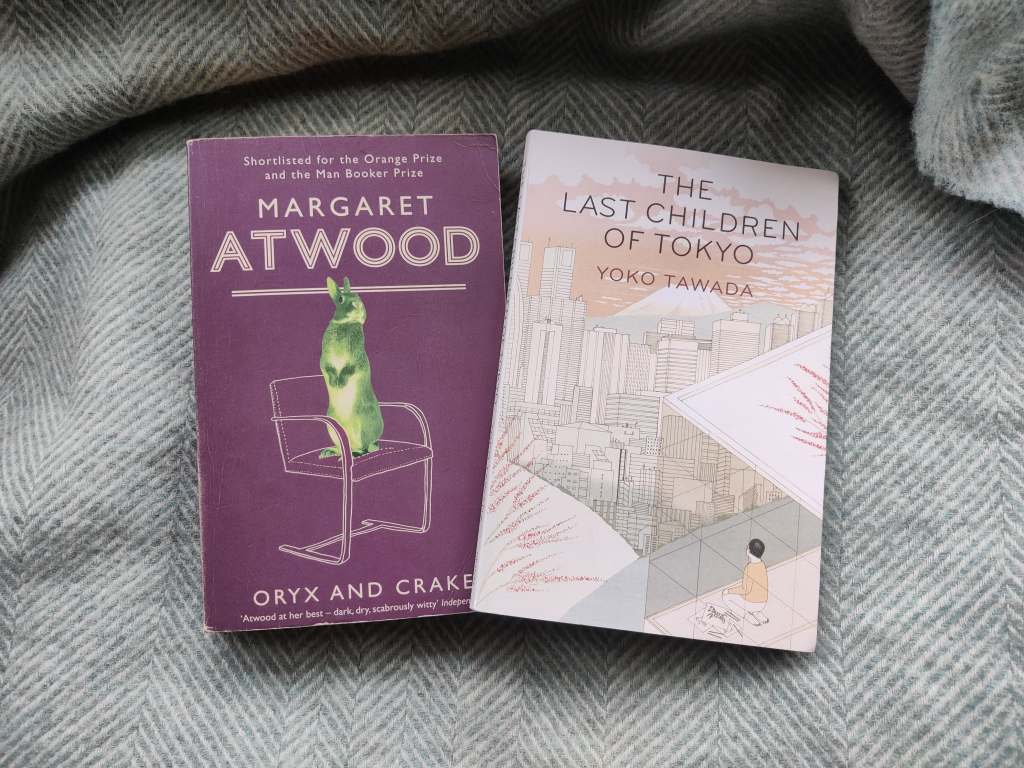
When I left Oxford, I was excited by the prospect of a new bookshelf to explore and choose from, hopefully picking reads that would genuinely provide me with some downtime rather than a downer. Before going, I picked up a familiar author, Yoko Tawada, from my housemate’s collection in hope this would set me on a path towards lighter reading. However, I fell into my usual trap unwillingly by failing to read the back cover copy.
The Last Children of Tokyo follows Toshiro, a hundred year-old Japanese man who believes he may never die. In this enchanting yet disturbing narrative, society has created new defined age groups, the young (0-50s), the young-elderly (60s-90s), and the old-eldery (90 and above), where the older generation are healthier than the young and remember a time before sea and air were poisoned. Due to the critical state of the world, Japan has closed its borders to all. The young are born with life-shortening conditions as a result of the diseased planet, such as Toshiro’s great-grandson, Mumei, whom he cares for diligently, and the seemingly immortal adults are left to watch the children of Japan suffer daily with little hope of making it to adulthood. Guilt and love ripples throughout the text’s carefully crafted lines as Yoshiro knows Mumei’s misfortunes are the fault of his generation’s selfishness, but little does he know that an underground network is at work and that Mumei may hold the key to saving them all.
Honestly, I would give it a 7/10. Although it is a short book, Tawada made every eloquent word count and I struggled to put it down. The narrative jumps from different people’s perspectives, including Mumei’s, his teacher, and Toshiro’s separated wife, making Toshiro’s personal reality and sorrows feel entwined with his world’s effortlessly. Without providing spoilers, I wasn’t enthralled with the ending but maybe this is something I need to re-read – it seemed to jump and end abruptly and I am unsure I processed what possible meanings Tawada was trying to insinuate.
Despite thoroughly enjoying Tawada’s novella, I felt almost grateful that it was a short read; I could move swiftly on to the next book rather than physically carrying around and wading through its unsettlingly, dystopian future. I decided I would take a different approach for my next choice and read a book which I’ve always wanted to read but haven’t found the right moment to do so: Margaret Atwood’s Oryx and Crake. Truly, I have no idea what I was thinking. If I was planning on picking a book to improve my mood, I should have known better.
Reading two dystopian novels centring on the downfall of our planet back-to-back ultimately made me feel incredibly hopeless, especially with Atwood’s infamous text focussing on the aftermath of a global, albeit man-made, pandemic. I don’t want to ruin Atwood’s work for those who haven’t read it yet, but I found myself spellbound in horror as she unveils how Snowman, otherwise known as Jimmy, arrives living in a tree, wrapped in a bedsheet, overlooking the Children of Crake as a traumatised, sunburnt, bug-bitten guardian. Atwood has said in interviews that she believes that her work falls into the category of ‘speculative fiction’ rather than sci-fi due to being rooted in genuine possibility, and while I disagree with her arguments I couldn’t argue with how the story made me feel. Sad, shook, and struck with the knowledge that this is the path that our planet is heading down.
Sitting on the sofa a little shell-shocked by Atwood’s prose, I decided that I truly needed to be kinder to myself and make a concerted effort to be more mindful of the literature and content I was reading. This doesn’t just include books – I mean all content I digest. Podcasts, social media, TV, radio, music. Having decided I can’t shy away from the news forever, I need to be practical in helping myself improve how I feel on a daily basis. As a way to conclude this post, I’ve included a list below of small things I am attempting to do to try and help this:
Spend less time on social media and unfollow anything/anyone that doesn’t bring lightness to your day.
Honestly, the amount of time I spend scrolling through social media looking at those that are seemingly happier than me has gotten unhealthy. I’ve tried following only those I truly care about or independent artists who post their artwork and it has helped tremendously. Someone recommended to me to download Pinterest instead and create moodboards of things you like to look at, such as saving some of your favourite artwork or images that make you smile, and I think that is a super positive thing to do.
Only read selected news outlets that you feel serves you, and then only read them morning and night.
Rather than getting overwhelmed with some of the ‘journalism’ we see today, I have decided to download a select number of news apps and only look in the morning and evenings. Things are rough. It’s not going to go away for now. You don’t need to read it constantly.
Listen to music or watch TV shows which are fun, even if they are satirical of our current world.
My Spotify playlist is as dreary as my bookshelf, so I have made an effort to find new bands which bring a bit of fun into my life and have a morning dance to. I’ve also started watching The Mandalorian (a bit late to the game, I know) which aligns with my sci-fi preferences but without the depressing undertones. Although the plot line is unimaginative, I like that it’s a bit cheery, there’s action, and each episode involves a new quest which is ultimately solved with a bow. I’ve also started watching Succession, and although it is based upon the infamous Murdoch family, it is absolutely hilarious. Sometimes you need to be satirical about current situations otherwise you’ll go mad.
Download audiobooks and hear stories in a different voice.
I haven’t done this yet, but I am aiming to download audible so I can listen to audiobooks again. Sometimes I think my internal voice can contribute to my down emotions, so listening to stories as removed from your own brain might help. It also means you aren’t limited to your physical bookshelf, and I think listen to Stephen Fry’s Mythos might do the trick in helping me sleep better.
Anyhow, I shall leave it there for now. If anyone has any suggestions of fun reads, I am always open to recommendations. Until then, look after yourselves.
Love,
Hev xo
 Heather Evans Editorial
Leave a comment