
Since handing in my dissertation and finishing university, I’ve struggled to pick up my pen, or, more accurately, to type anything down. I have been telling myself that this is because I need a break after all that hard work; that I am too busy doing fun things I was unable to do whilst in the studious mindset. Truthfully, I think it is because I haven’t had really anything to say or any inspiration to write upon. I don’t want to fill up a silence for the sake of it with words that aren’t important to anyone, let alone myself. Yet, here I am typing away fluidly. Now, I do have something I want to express, and I think it is important. To me, anyway.
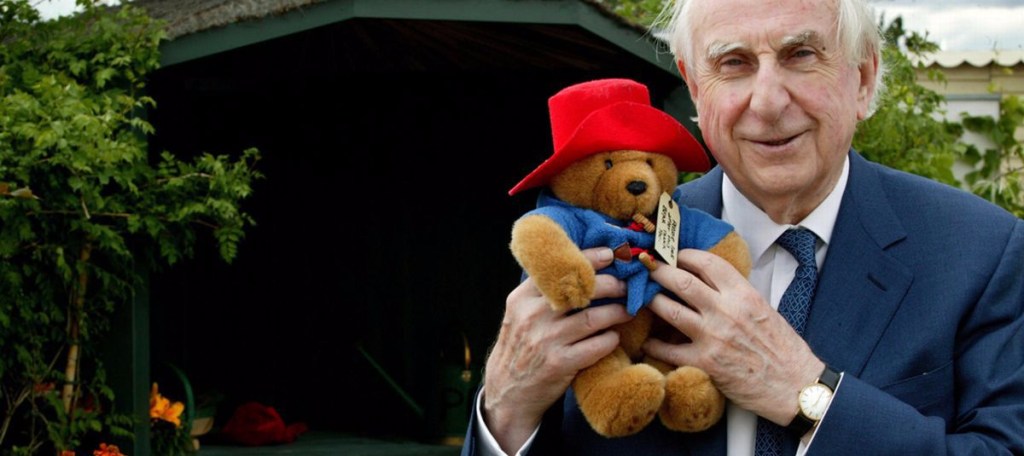
Michael Bond is important, and will forever remain significant in our world. I say ‘is’ because, despite his unfortunate passing, Michael Bond and his influence on our culture will never be put in the past; his legacy forever existing in our present and continuing on in our future. Although many people may not instantly realise Michael’s Bond’s significance in himself, I would be surprised if any child or adult did not know of his friendly, furry creation.

Paddington – the marmalade loving bear from deepest, darkest Peru.
Yet, he is more than just a bear, much like how Bond is more than just Paddington’s father. He is a symbol of acceptance and love which I think some people need reminding of. Especially with the current state of the world at the moment.
In fact, many people forget that Paddington was conceived during a time of turmoil, somewhat comparable to the world currently. I know that we are not living during WW2, which provided the seed for Bond’s creation, but with Trump shaking hands with Putin and North Korea doing some casual missile tests, we can all agree that we have no idea where our future is heading. I mean, apparently ‘experts’ aren’t important anymore according to the extremely flawed and questionable logic of Donald.
Nonetheless, Thomas Michael Bond did live in a war zone. After finishing school at the age of 14, WW2 was underway. He survived an air-raid after his work building was attacked, joining the RAF at 17 to later join the Middlesex Regiment of the British Army in 1947. He began writing in 1945, with the birth of Paddington arriving in 1958 with A Bear Called Paddington hitting the shelves. Being a solider, writer, and also working as a camera operator for the BBC, Bond is as flexible in his skill set as 007 himself.
We all know the story of Paddington, or we all should do in some capacity, so it would be a waste of my time going into depth about the narrative. However, some people, and I am one of these individuals in the past, don’t realise that Paddington represents a refugee during WW2. Think about it:
- He is shipped away by his Aunt Lucy because his home is no longer safe.
- He arrives at a foreign location with customs that differ from his own.
- He looks different to those that inhabit London, encountering prejudice.
- He has traveled extensive lengths for his safety, with barely (or bearly) any belongings but some marmalade. Let alone any family.
- He wears a ticket which states ‘Please look after this bear’ like many WW2 refugees did.
The correlation is undoubtedly there.
As readers, or spectators when watching Paddington, we root for the little, lost bear. We see where he comes from. We feel sympathy for him; he has lost his home and has no idea about the safety of his family. We want some generous soul to pick him up from Paddington station – to see how Paddington is as sweet as the marmalade he engulfs. Just look at that face.

How could you possibly reject him? Yes, he might be different. Of course, he is not aware of the different social etiquette expected in London. But surely he is worth a chance. Surely, he should be treated with the same respect.
Luckily, Paddington is given a shot. By the end of the series, Mr. Brown learns to accept Paddington for his differences. He learns to love the bear for who he is rather than profusely trying to get rid of him. Mr Brown helps Paddington on his way rather than making his new life more difficult. This story truly is about acceptance.
When reading Bond’s work, we can’t understand why Mr Brown, or any other commuter that walks pass Paddington, does not pick up the adorable bear. Yet, is this because we have seen his whole story? Is this because Paddington is a fluffy, harmless animal that we have gotten to know instead of being a terrifying, foreign presence?
We possess this strong, emotional attachment and will for Paddington throughout his journey, which we can see is Bond’s aim. To show how refugees during the war deserve love and acceptance in a new place; in a new home. I just believe that we should transpire these feelings we have towards a bear towards humanity. To help all Paddingtons we see that aren’t accepted for their differences. Although Bond provides us with a narrative prior to Paddington’s arrival in London, we don’t know everyone’s beginning. Rather than placing prejudice where is it not due, a little bit of kindness goes a long way.
This is why I think Bond and his bear are still so important. Although Paddington has become a cultural figure, we still need to keep reading Bond’s message of acceptance in a time of trouble. Paddington’s adventures are still as relevant to our society as they were then. Maybe we should all pick up a Paddington book. Not just for the few, but for the many.
Happy reading!
Hev xo
 Heather Evans Editorial
Leave a comment